Deadline
-
TBD
ET

Industrial Training and Assessment Center (ITAC) Re-compete

Information

Description

The Federal Government has been funding the university-based Industrial Training and Assessment Center (ITAC) program since 1976. The goal of this ITAC program is twofold: first, to help U.S. manufacturing competitiveness by providing assessments and recommendations to improve operations for small and medium-sized manufacturers/enterprises (SMEs), and second, to address a shortage of engineering professionals with applied energy and manufacturing-related skills by training engineering students through hands-on involvement in these assessments. To date, and under the direction of the U.S. Department of Energy (DOE) the university-based ITAC program has provided more than 23,000 assessments and over 169,000 recommendations to enhance competitiveness of SME operations. On average, an ITAC assessment leads an SME to implement changes that reduce its energy use and/or improve productivity by 5-7%.    

The university-based ITAC program has long been characterized by its ability to adapt to changing needs of its clients and to incorporate advancing technologies and emerging policy priorities. In particular, the U.S. is currently facing a major workforce availability and readiness issue for addressing critical minerals and materials (CMM) supply chains. To meet surging demand and reduce dependency on foreign CMM, the U.S. will need more new and upskilled workers, from technicians and trades to advanced-degree specialists, and it will need them across the entire CMM supply chain.  

Domestic mining operations face increasing pressure to reduce energy intensity, improve water efficiency and stewardship, enhance mineral recovery and process efficiency, address maintenance backlogs and aging infrastructure, and close workforce and technology capability gaps. At the same time, the mining workforce pipeline requires hands-on, systems level training that connects engineering fundamentals to real industrial constraints. DOE intends to leverage the extensive experience gained through operating the traditional ITAC program by expanding into the mining and mineral processing sectors, including, but not limited to CMMs.

Objective

The current 36 ITACs located across the country are completing their most recent five-year projects at the end of 2026. Through this opportunity, DOE anticipates selecting the universities who will operate two types of ITACs for the next five-years – the traditional manufacturing ITACs (Track 1) and a new variant that focuses on mining and mineral processing operations (Track 2).  

DOE’s Office of Critical Minerals and Energy Innovation (CMEI) intends to provide opportunities for applicants across a range of four-year educational institutions that provide engineering degrees. Specifically, U.S. colleges or universities that have at least one of their four-year undergraduate programs accredited by the Engineering Accreditation Commission or the Technology Accreditation Commission of the Accreditation Board for Engineering and Technology (ABET). The applicants must be located within the engineering department that holds the accreditation and must be physically located in the U.S. Applicants can apply to either or both of the following two tracks.

Track 1:  Manufacturing ITACs

The universities selected to operate Manufacturing ITACs under this Opportunity are expected to continue the traditional activity of providing technical assistance in the form of assessments to SMEs – currently defined as operating within Standard Industrial Classification (SIC) codes 21 thru 39, having gross annual sales below $250M, fewer than 500 employees, and annual energy bills between $100,000 and $3.5M. The critical elements of the traditional university-based ITACs are as follows:

  • Train both new and existing students annually in the principles of energy engineering, productivity improvement, and resource management.
    ITACs train the future energy and manufacturing workforce by providing hands-on experience for engineering students who will conduct assessments at SMEs. The assessments result in energy and water savings, waste reduction and productivity improvements for SMEs, as well as identify cybersecurity vulnerabilities and opportunities for smart manufacturing, resiliency planning, and deployment of artificial intelligence solutions. ITACs may also provide a limited number of special assessments (i.e., falling outside the SME criteria specified above) that DOE approves in the best interest of enhancing the student experience as well as resulting in energy savings and other benefits for the recipient of the assessment.
  • Issue certificates of achievement to at least half of the number of incoming students annually.
    DOE issues Certificates of Achievement to students that meet minimum criteria for successful participation in the program. The certification criteria were established by ITAC Directors, reviewed by ITAC Lead Students, and approved by senior DOE leadership.
  • Following the on-site assessments, conduct timely follow-on reporting, tracking, implementation, and management improvement activities.
    Within 60 days of the completion of the assessment, ITACs issue a comprehensive assessment report to the SME detailing opportunities for energy-related and other savings, recommended productivity improvements, and other best practices – including estimated implementation costs and simple payback periods. Within 9 to 12 months after the assessment, ITACs confirm the implementation status of all these assessment recommendations with each SME.
  • Describe and engage regional industrial base.
    To understand context and to maximize the impact of the ITAC program, ITACs will identify who they will engage within their regional SME population to promote the expertise of their students and the availability of the assessments that they will provide.
  • Promote ITAC services and complementary ITAC programs.
    ITACs will identify how they will advocate for the complementary ITAC Implementation Grants program. Domestic manufacturing can be assisted significantly not only through ITAC assessments, but also through the additional step of applying for capital to implement the recommendations that arise from these assessments.
  • Develop and communicate resources that advance the mission of the ITAC program and support other SMEs.
    Despite the nationwide coverage of the network, ITACs can only provide direct technical assistance to a portion of the SME universe. Therefore, ITACs will contribute at least one readily replicable case study, success story, and/or energy engineering systems research project that can be deployed across the relevant manufacturing sectors.
  • Conduct special projects that further enhance student workforce development or other center performance activities.  
    As part of their specialized energy engineering experience, undergraduate and graduate students can pursue assessment-inspired research projects that are consistent with approved SOPO activities.
  • Provide other high-quality, value-added services to SMEs.
    These would include implementation/deployment projects or feasibility studies/analysis related to artificial intelligence and smart manufacturing solutions deployed in a retrofit context, energy management, critical materials processing, or other emerging issues.

Track 2:  Mining and Mineral Processing ITACs

The universities selected to operate these more specialized ITACs will focus on providing technical assistance to SMEs within SIC Codes 10 - 14 and 32 (i.e., mining and mineral processing), having gross annual sales below $250M, and fewer than 500 employees.  

Although the basic structure and operation of these ITACs are consistent with the traditional manufacturing ITACs, the clients to be served, the technical challenges they face, and the time required to evaluate and recommend potentials solutions to these challenges will likely increase the time required for technical assistance, as well as expand the academic disciplines of the participating students. The critical elements of the mining and mineral processing ITACs are as follows:

  • Train both new and existing students annually in the principles of mineral recovery and processing, operational excellence, energy and water resource management, maintenance and reliability, worker health and safety, and technology analysis.  
    ITACs will train the future mining and mineral processing workforce by providing hands-on experience for students who will conduct assessments at relevant SMEs. Students will also explore opportunities for resiliency planning and deployment of artificial intelligence solutions. ITACs may also provide a limited number of special assessments (i.e., falling outside the criteria specified above) that DOE approves in the best interest of enhancing the student experience as well as resulting in other benefits for the recipient of the assessment.
  • Issue certificates of achievement to at least half of the number of incoming students annually.  
    DOE issues Certificates of Achievement to students that meet minimum criteria for successful participation in the program. The certification criteria will be established by ITAC Directors and approved by senior DOE leadership.
  • Following the on-site assessments, conduct timely follow-on reporting, tracking, implementation, and management improvement activities.
    Within 120 days of the completion of the assessment, ITACs issue a comprehensive assessment report to the SME detailing opportunities for operational improvement, resource management, and other best practices – including estimated implementation costs and simple payback periods. Within 12 to 18 months after the assessment, ITACs confirm the implementation status of all these assessment recommendations with each SME.
  • Describe and engage regional mining and mineral processing base.  
    To understand context and in order to maximize the impact of the ITAC program, ITACs will identify who they will engage within their regional mining and mineral processing population to promote the expertise of their students and the availability of the technical assistance that they will provide.
  • Promote ITAC services and complementary ITAC programs.
    ITACs will identify how they will advocate for the complementary ITAC Implementation Grants program. Domestic mining and mineral processing operations can be assisted significantly not only through ITAC assessments/technical assistance, but also through the additional step of applying for capital to implement the recommendations that arise from these activities.
  • Develop and communicate resources that advance the mission of the ITAC program and support other SMEs.
    Despite the nationwide coverage of the network, ITACs can only provide direct technical assistance to a portion of the SME universe. Therefore, ITACs will contribute at least one readily replicable case study, success story, and/or mining and mineral processing research project that can be deployed across the relevant sectors.
  • Conduct special projects that further enhance student workforce development or other center performance activities.  
    As part of their specialized mining and mineral processing engineering experience, undergraduate and graduate students can pursue assessment-inspired research projects that are consistent with approved SOPO activities.
  • Provide other high-quality, value-added services to SMEs.
    These would include implementation/deployment projects or feasibility studies/analysis related to artificial intelligence solutions, energy management, critical materials processing, or other emerging issues.

Event Updates
Important Dates

Submission Deadline(s)

More information will be coming soon.

DOE Announcement

The DOE announcement will be posted when the Opportunity is officially launched.

Informational Webinar(s)

More information will be coming soon.

Process Details

Timeline(s)

More information will be coming soon.

Webinar Resources

Coming soon.

Slide Deck(s)

Coming soon.

Transcript(s)

Coming soon.

Video Recording(s)

Coming soon.

Webinar Q&As

Coming soon.

Eligibility & Review Criteria

Eligibility Criteria

Every applicant and sub-applicant(s) must meet the following eligibility requirements:

  • Must be domestic entities. To qualify as a domestic entity, the entity must be organized, chartered, or incorporated (or otherwise formed) under the laws of a particular state or territory of the United States; have majority domestic ownership and control; and have a physical place of business in the United States.
  • In good standing for Federal program participation. Entities banned from doing business with the United States government such as entities debarred, suspended, or otherwise excluded from or ineligible for participating in Federal programs are not eligible. Additionally, nonprofit organizations described in Section 501(c)(4) of the Internal Revenue Code of 1986 that engaged in lobbying activities after December 31, 1995, are not eligible to apply for funding.

Please note that federally funded research and development centers (FFRDCs) are eligible as sub-applicants, but will be funded outside of the PIA if selected.

Review Criteria for Track 1: Manufacturing ITACs

Applications for Track 1 will be evaluated against the technical review criteria shown below. All sub-criteria are of equal weight.

Criterion 1: Project Management Approach (30%)

This criterion involves consideration of the following factors:  

  • Demonstrated understanding of Program goals, objectives, and responsibilities.  
  • Effectiveness of proposed organizational model for achieving Program goals, objectives, and responsibilities.  
  • Demonstrated ability to use technology and data tools to support achievement of Program goals, objectives, and responsibilities.  
  • Completeness and reasonableness of proposed workplan and milestones.  
  • Adequacy of identification of risks and timely and appropriate strategies for mitigation and resolution.  

Criterion 2: Project Team and Past Performance (25%)

This criterion involves consideration of the following factors:  

  • Qualifications of proposed professors and staff, including past experience with industrial facilities, providing student training in energy related matters, and active integration with existing curriculum.
  • Technical expertise and experience working with small- and medium-sized manufacturers to improve energy efficiency, material efficiency, productivity, cybersecurity and resilience, and reduce waste.
  • Demonstrated ability to provide or facilitate high-quality training and education to students and small- and medium-sized manufacturers regarding new and priority technologies, tools, and practices.
  • Demonstrated ability to work effectively with governmental and nongovernmental stakeholders to advance program goals and objectives.
  • Demonstrated experience engaging in outreach to small- and medium-sized manufacturers.

Criterion 3: Teaching, Training, Workforce Development, and Job Quality (30%)

This criterion involves consideration of the following factors:  

  • Quality of plan to support development and delivery of effective mentoring, training, and curricular resources to ITAC staff, students, and trainees.  
  • Quality of plan to support development and delivery of effective technical resources and solutions to small- and medium-sized manufacturers and their workers in a variety of formats.  
  • Quality of plan to support student-focused activities, including connecting graduates and private industry, supporting student research competitions, recognizing achievements, and maintaining alumni involvement.  
  • Quality of plan to work with small- and medium-sized manufacturers to support workforce education and training leading to opportunities for incumbent workers to learn and earn credentials.  

Criterion 4: Project Budget and Resources (15%)

This criterion involves consideration of the following factors:  

  • Reasonableness of budget and spend plan for proposed project and objectives.  
  • Adequacy of facilities, equipment, and other resources.  
  • Level of commitment from the proposing college or university and the host department that a Center will have strong administrative support as well as support from other departments, potentially including business, marketing, communications, IT, and other areas.  

Review Criteria for Track 2: Mining and Mineral Processing ITACs

Applications for Track 2 will be evaluated against the technical review criteria shown below. All sub-criteria are of equal weight.  

Criterion 1: Project Management Approach (30%)

This criterion involves consideration of the following factors:  

  • Demonstrated understanding of Program goals, objectives, and responsibilities.  
  • Effectiveness of proposed organizational model for achieving Program goals, objectives, and responsibilities.  
  • Demonstrated ability to use technology and data tools to support achievement of Program goals, objectives, and responsibilities.  
  • Completeness and reasonableness of proposed workplan and milestones.  
  • Adequacy of identification of risks and timely and appropriate strategies for mitigation and resolution.  

Criterion 2: Project Team and Past Performance (25%)

This criterion involves consideration of the following factors:  

  • Qualifications of proposed professors and staff, including past experience with mining and mineral processing facilities, providing student training in related matters, and active integration with existing curriculum.
  • Technical expertise and experience working with mining and mineral processing facilities to improve energy efficiency, productivity, resilience, and resource utilization.
  • Demonstrated ability to provide or facilitate high-quality training and education to students and mining and mineral processing facilities regarding new and priority technologies, tools, and practices.
  • Demonstrated ability to work effectively with governmental and nongovernmental stakeholders to advance program goals and objectives.
  • Demonstrated experience engaging in outreach to mining and mineral processing facilities.

Criterion 3: Teaching, Training, Workforce Development, and Job Quality (30%)

This criterion involves consideration of the following factors:  

  • Quality of plan to support development and delivery of effective mentoring, training, and curricular resources to ITAC staff, students, and trainees.  
  • Quality of plan to support development and delivery of effective technical resources and solutions to mining and mineral processing facilities and their workers in a variety of formats.  
  • Quality of plan to support student-focused activities, including connecting graduates and private industry, supporting student research competitions, recognizing achievements, and maintaining alumni involvement.  
  • Quality of plan to work with mining and mineral processing facilities to support workforce education and training leading to opportunities for incumbent workers to learn and earn credentials.  

Criterion 4: Project Budget and Resources (15%)

This criterion involves consideration of the following factors:  

  • Reasonableness of budget and spend plan for proposed project and objectives.  
  • Adequacy of facilities, equipment, and other resources.  
  • Level of commitment from the proposing college or university and the host department that a Center will have strong administrative support as well as support from other departments, potentially including business, marketing, communications, IT, and other areas.

Frequently Asked Questions

SOO-29 VO-6 Provider Round 2 FAQ
SOO-29 VO-6 Provider Round 2 (Coming Soon) FAQ
SOO-42 iCRS-T (Recipients) FAQ
SOO-44 VO-12 Grid Innovations Facility and Testing (Providers) FAQ
SOO-29 VO-6 Recipient Round 2 (Coming Soon) FAQ
SOO-29 VO-6 Recipient Round 2 FAQ
SOO-49 Legacy ITAC FAQ
May an FFRDC or a National Lab apply?

DOE will not directly fund National Labs*/FFRDCs via this Partnership Intermediary Agreement (PIA) Opportunity; however, FFRDCs (e.g. DOE/National Nuclear Security Administration national laboratories) may participate as a Selectee’s subrecipient.  The FFRDC effort, in aggregate, shall not exceed 10% of total federal share of the project, and ENWX and DOE will not be involved in, nor assist in, these activities.  Selectees will receive full funding through a Business-to-Business (B2B) Agreement with ENWX.  Selectees are solely responsible for funding and executing necessary agreements with subrecipients.  

*Caveat:  NLs may be Voucher Providers and may apply, but if selected, DOE will manage the work and pay the NL directly through the existing funding mechanism.

‍What are Smart Manufacturing and high-performance computing?

For the purposes of this opportunity:

“Smart Manufacturing” means advanced technologies in information, automation, monitoring, computation, sensing, modeling, artificial intelligence, analytics, and networking that can -

  • simulate manufacturing production lines;
  • operate computer-controlled manufacturing equipment;
  • monitor and communicate production line status; and
  • manage and optimize energy productivity and cost throughout production;
  • model, simulate, and optimize the energy efficiency of a factory building;
  • monitor and optimize building energy performance;
  • model, simulate, and optimize the design of energy efficient and sustainable products, including the use of digital prototyping and additive manufacturing to enhance product design;
  • connect manufactured products in networks to monitor and optimize the performance of the networks, including automated network operations; and
  • digitally connect the supply chain network.16

“High-Performance Computing” means the use of supercomputers, sophisticated models, and/or large data sets to study and solve complex scientific and technological challenges.

What exactly is a “small- and medium-sized manufacturer”?

The term “small- and medium-sized manufacturer” (SMM) means manufacturing firms:

  • classified in the North American Industry Classification System (NAICS) as any of sectors 31 through 33;
  • with gross annual sales of less than $100,000,000;
  • with fewer than 500 employees at the plant site; and
  • with annual energy bills totaling more than $100,000 and less than $3,500,000
Who is eligible to receive funding?

Refer to Section III.G.2. Eligibility Requirements in the Solicitation Overview.

An application’s prime recipient must be one of the following eligibility entities, else the application will be considered ineligible and removed from further evaluation:

  • State entity;
  • State-funded university; or
  • State-funded community or technical college
Are applicants required to provide cost share?

Yes, cost sharing is required under this solicitation. Applicants are required to provide at least a 23.1% cost share, i.e. applicants need to fund a minimum of 23.1% of the total project cost. Cost share can come from any non-federal source, i.e. cash on hand, philanthropy, corporate investment, etc.

What is the difference between "cost sharing" and "cost match"?

Refer to the Cost Share handout for more detail and examples.

  • While the terms “cost sharing” and “cost matching” are sometimes used interchangeably, there is an important distinction between them. DOE uses “cost sharing” to indicate that the non- federal share is calculated as a percentage of the Total Project Cost. On the other hand, for “cost matching”, the non-federal match is calculated as a percentage of the federal funds only, rather than the Total Project Cost.
  • The statutory language that authorizes the State Manufacturing Leadership Program requires proponents to provide at least 30 percent cost match. For the purposes of this solicitation, the 30 percent cost matching requirement has been converted to an equivalent 23.1 percent cost sharing requirement
What are the acronyms SMM, HPC, and SLMP?
  • SMM = small- and medium-sized manufacturers
  • HPC = high-performance computing
  • SMLP = State Manufacturing Leadership Program
  • IAC = Industrial Assessment Center
  • ITAC = Industrial Training and Assessment Center
  • TA = Technical Assistance
Why did the solicitation come down mid-January?

The solicitation was temporarily taken down while DOE and ENERGYWERX confirmed that the language was consistent with recent Executive Orders.

What is an Opportunity?

Understanding Opportunities

An opportunity is a favorable circumstance or situation that allows for the potential to achieve a goal or benefit. In various contexts, opportunities can arise in business, education, and personal development. Recognizing and seizing these moments can lead to significant advancements in one's career or personal life.

Types of Opportunities

  • Career Opportunities: Job openings or promotions that can enhance your professional journey.
  • Educational Opportunities: Programs or courses that provide knowledge and skills.
  • Networking Opportunities: Events or platforms that allow you to connect with others in your field.
Download

Is there cost share?

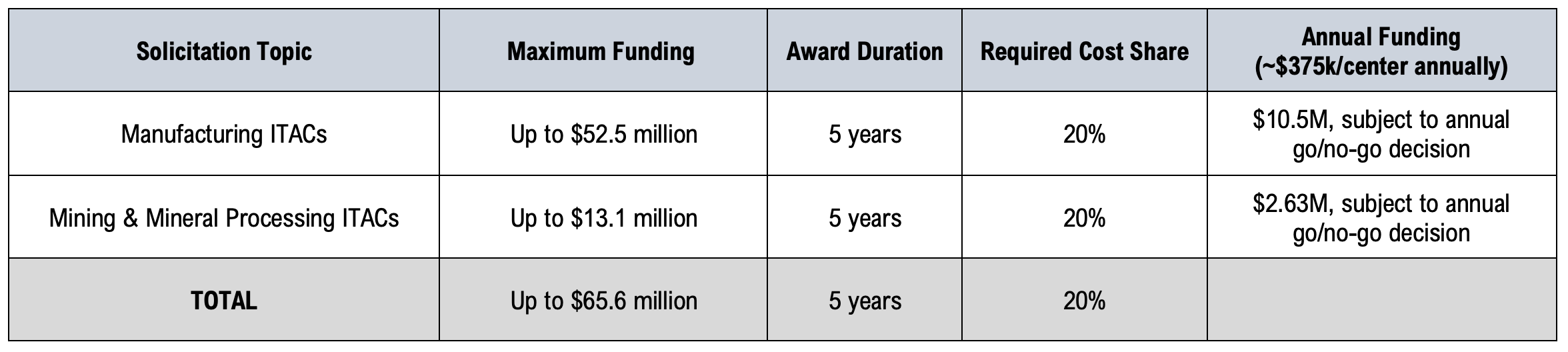
A 20% cost share is required for any awardee (Tracks 1 and 2) under this solicitation. Awardees will be expected to provide documentation of their cost share. For details on eligible cost share expenses, please visit the FAQs.  

Do you encourage partnerships with stakeholders?

Partnerships with other stakeholders are strongly encouraged, including formal sub-applicants and other implementation partners. All sub-applicants must meet the General Eligibility Requirements noted above.  

Should there be coordination with Other Manufacturing Investment and Industrial or Mining/Mineral Processing Assistance Efforts?

DOE encourages responses to this solicitation that coordinate with, leverage, and build upon existing programs and entities, including:  

  • Department of Labor-recognized High Road Training Programs  
  • DOE’s Better Plants program, Onsite Energy Technical Assistance Partnerships, and the ISO 50001 program  
  • Manufacturing USA Institutes  
  • National Institute of Standards and Technology’s Manufacturing Extension Partnership (MEP)  
  • State Energy Offices and Programs  
  • Department of Labor Mine Safety and Health Administration, and  
  • Other related Federal, State, and Tribal efforts  

What is the estimated funding level and award duration?

What should be submitted with my application?

A complete application for Tracks 1 and/or 2 of this solicitation requires:

  • online questionnaire,
  • project narrative (submitted as an attachment to the questionnaire),
  • letters of commitment from all sub-applicants and third-party cost share providers,
  • resumes for key personnel, and  
  • project budget, as detailed below.  

Additionally, the applicant must certify it is not owned by, controlled by, or subject to the jurisdiction or direction of government of Country of Risk. DOE defines Country of Risk to include China, Russia, North Korea and Iran. This list is subject to change.  

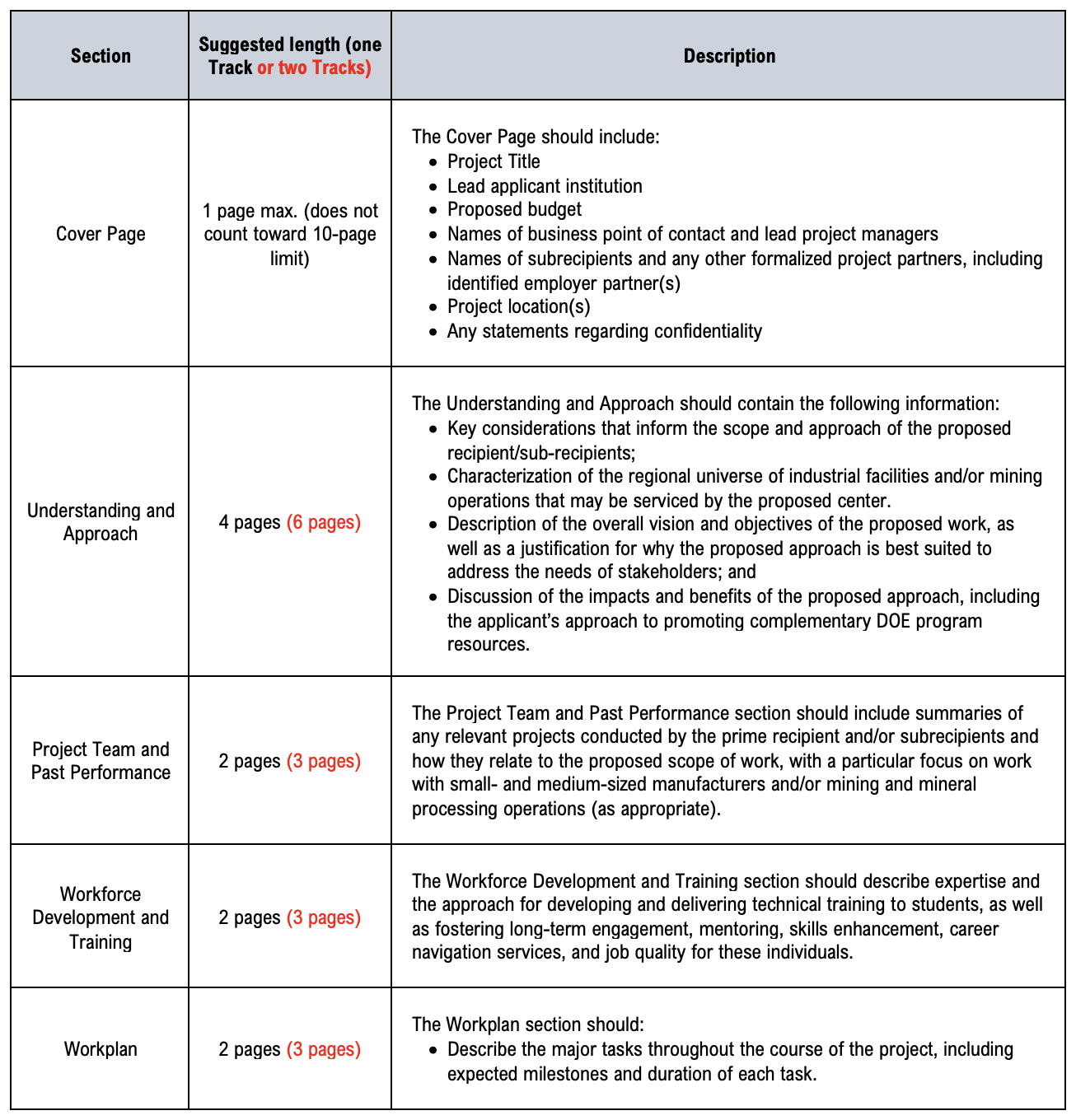
The project narrative cannot exceed 10 pages in total (excluding the cover page) using 12-point font and 1-inch margins, including supporting visualizations or graphics. If an applicant elects to submit a proposal for multiple Tracks, the overall page limit for the project narrative is increased by 5 pages.  

Any content exceeding 10 pages for one Track or 15 pages for two Tracks will not be considered by reviewers. Note that the letters of commitment, resumes, and budget workbook DO NOT COUNT towards the page limit.

The table below outlines the content that should be in the project narrative.

If selected, performers will establish a business-to-business agreement with EnergyWerx and define project activities (e.g., tasks, milestones, deliverables) in a concise Statement of Effort (SOE) document. DOE also expects awardees to provide regular updates on progress through quarterly calls and concise reports, and to participate in peer-to-peer learning opportunities/workshops a few times per year.  

Letters of Commitment

Submit letters of commitment from all sub-applicants and third-party cost share providers. If applicable, the letter must state that the third party is committed to providing a specific minimum dollar amount or value of in-kind contributions allocated to cost sharing. The following information for each third party contributing to cost sharing should be identified: (1) the name of the organization; (2) the proposed dollar amount to be provided; and (3) the proposed cost sharing type (cash or in-kind contributions).  

Each letter must not exceed 1 page. Save the letters of commitment in a single PDF using the following convention for the title “LeadOrganization_LOCs”.  

Letters of support or endorsement for the project from entities that do not have a substantive role in the project are not accepted or reviewed.  

Resumes for Key Personnel

Applicants must submit a one-page resume for the Project Director and up to five additional senior/key personnel. The resumes should include the following:  

  • Contact Information;  
  • Education and training: Provide institution, major/area, degree, and year for undergraduate, graduate, and postdoctoral training;  
  • Research and Professional Experience: Beginning with the current position, list professional/academic positions in chronological order with a brief description. List all current academic, professional, or institutional appointments, foreign or domestic, at the applicant institution or elsewhere, whether or not remuneration is received, and, whether full-time, part-time, or voluntary; and  
  • Awards and honors.  

Save resumes in a single PDF using the following convention for the title “LeadOrganization_Resumes”.  

Project Budget

Applicants must complete the Project Budget, which is found on Submittable. DOE anticipates the maximum per center allocation will be $375,000 per year. Applicants must complete each tab of the Project Budget for the project as a whole, including all work to be performed by the prime recipient and its sub-recipients and contractors. Applicants must carefully read the instructions in the “Description/Explanation/Details” column of each sheet. Save the Budget Justification Workbook in a single Microsoft Excel file using the following convention for the title “LeadOrganization_Budget”.