Deadline
-
TBD
July 28, 2026
3:00 pm
ET

Voucher Opportunity 12 - Grid Innovations Facility and Testing (Providers) (VO-12)

Information

Description

The Grid Innovations Facility and Testing Voucher will connect U.S. small businesses, innovators, and entrepreneurs with the resources, capabilities, and facilities needed to spur advancements in next-generation grid technologies to meet pressing industry needs.

This Voucher Opportunity seeks to provide U.S.-based grid Technology Developers with the testing services needed to increase technical readiness and commercialization potential of innovative electric transmission and distribution technologies (note: energy storage technologies are not in scope). This Voucher Opportunity, developed in partnership between the U.S. Department of Energy’s Office of Electricity (DOE-OE) and ENERGYWERX, facilitates matchmaking between U.S.-based electric grid Technology Developers (Voucher Recipients) and domestic Test Facilities (Voucher Providers) with relevant testing capabilities. Once matches are made, OE funds the Test Facilities to provide these testing services to the Technology Developers for projects lasting up to one year.

Vouchers will be distributed as in-kind support, meaning that ENERGYWERX will directly reimburse the Voucher Provider for the work they have completed on behalf of the Voucher Recipients. The value of each Voucher will depend on the services defined in the Providers’ capability statements, with estimated values of support services per Recipient ranging from $50k to $250k.

Objective

The Voucher Program aims to build bridges between U.S. entrepreneurs, businesses, Technology Developers or other relevant entities and third-party Voucher Providers to advance commercialization and demonstration at scale of innovative grid technologies. Voucher Opportunity (VO-12) includes testing, stress testing, performance validation, and evaluation support for U.S. companies who are currently developing precommercial electric grid technologies.

Vouchers may provide support and expertise to test and validate hardware and/or software for technologies with Technology Readiness Levels (TRL) of TRL 6 (engineering/pilot‐scale, similar (prototypical) system validation in a relevant environment) to TRL 8 (actual system completed and qualified through test and demonstration). Testing activities should lead to technological risk reduction, improvements in performance, applicability, and durability, and relevant data to accelerate adoption in the United States.

The first submission window solicits proposals from potential Voucher Providers. A second submission window will be open soon after to solicit requests from potential Voucher Recipients. Pending availability of funds, additional submission windows may open in the future. 

Voucher Providers (Test Facilities): Domestic national, federal, private, or university labs with one or more testing capabilities directly relevant to electric grid technologies.

Note: Test Facilities may be a part of a larger organization (e.g., National Laboratory) with multiple facilities but generally operate independently and with a significant level of autonomy.

Voucher Recipients (Technology Developers): U.S.-based companies, small businesses, start-ups, research organizations, or academic institutions developing and commercializing a new electric grid technology for transmission and/or distribution systems.

Testing Capabilities (or Capability): The technical support service provided by a Test Facility to achieve a specific testing objective that advances the understanding or technical readiness of a grid innovation via physical or simulated testing in a controlled environment. Capabilities are provided at a fixed cost, set by the Voucher Provider, and must be repeatable and time-bound with measurable deliverables and outcomes. Capabilities should include the lab spaces, equipment, procedures, staff (including expertise and labor), time, site access, and other resources to complete the testing objective. Capabilities may include modeling, simulation, analysis, or other software services if paired with an eligible testing service. This Voucher Opportunity does not provide funds to establish new testing capabilities or significantly modify existing testing capabilities for the Voucher Provider. Capability categories and sub-categories are provided in the Downloadable Files section.

Voucher Projects: Electric grid technology testing activities conducted by a selected Voucher Provider-Recipient pair. Vouchers for testing services, worth between $50,000 - $250,000, will be distributed as in-kind support, meaning that ENERGYWERX will directly reimburse the Voucher Provider for the work they have completed on behalf of the Voucher Recipients.

DOE anticipates issuing approximately 16-20 Vouchers.

Event Updates

Important Dates

Submission Deadline(s)

Submission Window: June 16, 2026 - July 28, 2026

  • Start the Voucher Opportunity 12 – Provider Application
    [application link] (Submissions are due no later than July 28, 2026 at 3:00 PM ET)

DOE Announcement

Please see the announcement article for more information.

Informational Webinar(s)

Voucher Provider Informational Webinars: DOE will present and summarize the details of the Voucher Opportunity. Potential Voucher Providers will gain a better understanding of the Voucher Program’s scope, scale, and intent and have the opportunity to ask questions of DOE staff.

  • Register for the Informational Webinar on June 23, 2026 at 3:00 PM ET
    • Focuses predominantly on explaining the Opportunity with some time for questions at the end.
  • Register for the Informational Webinar on July 21, 2026 at 3:00 PM ET
    • Focuses predominantly on answering questions from potential applicants.
For an optimal experience, we recommend downloading the Microsoft Teams software to your computer, smartphone, or tablet.

Process Details

Timeline(s)

Phase 1 – Voucher Provider Capability Submissions Open (June 16, 2026 – July 28, 2026)

  • Informational Webinar(s): DOE will present and summarize the details of the Grid Innovation Facility and Testing Voucher Opportunity. Potential Voucher Providers will gain a better understanding of the Voucher Program’s scope, scale, and intent and have the opportunity to ask questions of the DOE staff.
    • June 23, 2026 from 3:00 PM – 4:00 PM ET
    • July 21, 2026 from 3:00 PM – 4:00 PM ET
  • DOE Selection (Timeline TBD): DOE will review submissions based on the selection criteria and will notify selected entities for next steps.
    NOTE: DOE may choose to meet with applicants or ask additional clarifying questions prior to selection.

Phase 2 – Voucher Recipient Applications and Matchmaking (Fall 2026): Electric Grid Technology Developers will apply to receive testing services and meritorious applications will be matched to one of the capabilities approved during Phase 1.

Phase 3 – Project Execution (Winter 2026): Matched Provider-Recipient pairs will establish project agreements with DOE or ENERGYWERX to define the scope of work, budget, timing, and outcomes. Projects will then have one calendar year to complete testing activities, including four standardized milestones. 

Webinar Resources

Coming soon.

Slide Deck(s)

Coming soon.

Transcript(s)

Coming soon.

Video Recording(s)

Coming soon.

Webinar Q&As

Coming soon.

Eligibility & Review Criteria

Eligibility Criteria

Eligible performers (Voucher Providers and Voucher Recipients) must meet the following criteria:

  1. Applicant qualifies as a domestic entity.  
  2. Applicant must certify that it is not owned by, controlled by, or subject to the jurisdiction or direction of government of Country of Risk.

To qualify as a domestic entity, the entity must be organized, chartered or incorporated (or otherwise formed) under the laws of a particular state or territory of the United States; have majority domestic ownership and control; and have a physical place of business in the United States. DOE defines Country of Risk to include China, Russia, North Korea, Iran, and Belarus. This list is subject to change. DOE retains the prerogative to require additional information from the applicants to verify the applicant meets the eligibility requirements.

Please review the Program Rules document and the Intellectual Property Management Plan included in the Downloadable Files for additional rules and considerations regarding project activities, NEPA, cost share, and intellectual property.

Review Criteria

The following criteria will be used by DOE to review and select Voucher Provider applications.

  • The proposed testing capabilities have direct relevance and benefit to cost-effective, scalable electric grid technologies and systems.
  • The proposed testing capabilities represent testing that can lead to clear advancements in technology readiness.
  • The proposed facility is located in the U.S. and meets the eligibility requirements.
  • The proposed facility is purpose-built for testing, has the appropriate permits to operate, and can complete the requisite NEPA review if needed.
  • The application is complete and indicates the necessary expertise, site access, equipment, and availability to conduct at least one testing activity a year if matched with an appropriate Technology Developer.
  • The scope, cost, and duration of the proposed project activities are reasonable and within the intended purpose of the Voucher.

DOE retains the prerogative to require additional information from the applicants to verify the applicant meets the eligibility requirements and selection criteria. DOE-OE may disqualify an application for any reason, including but not limited to if the applicant engages with the Voucher Program in a manner that, in the sole discretion of the DOE-OE, is indecent, obscene, or lacking in professionalism. This includes but is not limited to the application itself, or any communication to Voucher Program staff.

The selection process for Voucher Recipient applications is competitive and subject to available funding. DOE retains the prerogative to decide whether to fund the proposed project entirely, partially, or not at all. Per DOE-OE’s discretion, applicants may be selected as an alternate to be awarded if funding becomes available. Awarding the Voucher is dependent on successfully establishing an agreement between the matched Voucher Provider and the Voucher Recipient.

Frequently Asked Questions

May an FFRDC or a National Lab apply?

DOE will not directly fund National Labs*/FFRDCs via this Partnership Intermediary Agreement (PIA) Opportunity; however, FFRDCs (e.g. DOE/National Nuclear Security Administration national laboratories) may participate as a Selectee’s subrecipient.  The FFRDC effort, in aggregate, shall not exceed 10% of total federal share of the project, and ENWX and DOE will not be involved in, nor assist in, these activities.  Selectees will receive full funding through a Business-to-Business (B2B) Agreement with ENWX.  Selectees are solely responsible for funding and executing necessary agreements with subrecipients.  

*Caveat:  NLs may be Voucher Providers and may apply, but if selected, DOE will manage the work and pay the NL directly through the existing funding mechanism.

‍What are Smart Manufacturing and high-performance computing?

For the purposes of this opportunity:

“Smart Manufacturing” means advanced technologies in information, automation, monitoring, computation, sensing, modeling, artificial intelligence, analytics, and networking that can -

  • simulate manufacturing production lines;
  • operate computer-controlled manufacturing equipment;
  • monitor and communicate production line status; and
  • manage and optimize energy productivity and cost throughout production;
  • model, simulate, and optimize the energy efficiency of a factory building;
  • monitor and optimize building energy performance;
  • model, simulate, and optimize the design of energy efficient and sustainable products, including the use of digital prototyping and additive manufacturing to enhance product design;
  • connect manufactured products in networks to monitor and optimize the performance of the networks, including automated network operations; and
  • digitally connect the supply chain network.16

“High-Performance Computing” means the use of supercomputers, sophisticated models, and/or large data sets to study and solve complex scientific and technological challenges.

What exactly is a “small- and medium-sized manufacturer”?

The term “small- and medium-sized manufacturer” (SMM) means manufacturing firms:

  • classified in the North American Industry Classification System (NAICS) as any of sectors 31 through 33;
  • with gross annual sales of less than $100,000,000;
  • with fewer than 500 employees at the plant site; and
  • with annual energy bills totaling more than $100,000 and less than $3,500,000
Who is eligible to receive funding?

Refer to Section III.G.2. Eligibility Requirements in the Solicitation Overview.

An application’s prime recipient must be one of the following eligibility entities, else the application will be considered ineligible and removed from further evaluation:

  • State entity;
  • State-funded university; or
  • State-funded community or technical college
Are applicants required to provide cost share?

Yes, cost sharing is required under this solicitation. Applicants are required to provide at least a 23.1% cost share, i.e. applicants need to fund a minimum of 23.1% of the total project cost. Cost share can come from any non-federal source, i.e. cash on hand, philanthropy, corporate investment, etc.

What is the difference between "cost sharing" and "cost match"?

Refer to the Cost Share handout for more detail and examples.

  • While the terms “cost sharing” and “cost matching” are sometimes used interchangeably, there is an important distinction between them. DOE uses “cost sharing” to indicate that the non- federal share is calculated as a percentage of the Total Project Cost. On the other hand, for “cost matching”, the non-federal match is calculated as a percentage of the federal funds only, rather than the Total Project Cost.
  • The statutory language that authorizes the State Manufacturing Leadership Program requires proponents to provide at least 30 percent cost match. For the purposes of this solicitation, the 30 percent cost matching requirement has been converted to an equivalent 23.1 percent cost sharing requirement
What are the acronyms SMM, HPC, and SLMP?
  • SMM = small- and medium-sized manufacturers
  • HPC = high-performance computing
  • SMLP = State Manufacturing Leadership Program
  • IAC = Industrial Assessment Center
  • ITAC = Industrial Training and Assessment Center
  • TA = Technical Assistance
Why did the solicitation come down mid-January?

The solicitation was temporarily taken down while DOE and ENERGYWERX confirmed that the language was consistent with recent Executive Orders.

What is an Opportunity?

Understanding Opportunities

An opportunity is a favorable circumstance or situation that allows for the potential to achieve a goal or benefit. In various contexts, opportunities can arise in business, education, and personal development. Recognizing and seizing these moments can lead to significant advancements in one's career or personal life.

Types of Opportunities

  • Career Opportunities: Job openings or promotions that can enhance your professional journey.
  • Educational Opportunities: Programs or courses that provide knowledge and skills.
  • Networking Opportunities: Events or platforms that allow you to connect with others in your field.
Download

What are the roles of ENERGYWERX and the Department of Energy?

The Voucher Program is directed by the U.S. Department of Energy Office of Electricity (DOE-OE) who is responsible for all selections and rulemakings. Voucher Opportunities (VO’s) are conducted through a Partnership Intermediary Agreement (PIA) with ENERGYWERX. PIA’s are “designed to increase outreach to and engagement with small business firms, institutes of higher education, and non-traditional partners.” PIA’s are an alternative to conventional financial assistance opportunities, like Notice of Funding Opportunity (NOFO) and work through an intermediary to provide streamlined and flexible solicitations that are approachable to entities unfamiliar with DOE funding programs.

ENERGYWERX was selected as the Partnership Intermediary for DOE’s PIA Pilot program, which started in 2023. ENERGYWERX is tasked with several pieces of the Voucher Opportunity, including management of the opportunity announcement webpage and application, engagement with applicants through Informational Webinars, and contracting of selected projects. ENERGYWERX acts as a neutral facilitator and resource for program participants.

Why is this called Voucher Opportunity-12 if this is the first round of applications?

In partnership with several DOE offices, ENERGYWERX has created a platform of Voucher Opportunities that support the commercialization of energy technologies and projects. The initial Voucher Opportunity is the twelfth program to begin work with ENERGYWERX, so it is referred to as VO-12, even though it is the first iteration of the Grid Innovation Facility and Testing Voucher Program.

How is matchmaking conducted?

In Phase 2, applicants are required to submit a prioritized list of pre-approved Capabilities that they would like to work with. The list of capabilities will be available on the Grid Innovation Facility and Testing Voucher Opportunity Website. During selections, the meritorious applications will be initially matched to a Voucher Provider based on the strength of the application, the relevance of testing needs and capabilities, the availability of the facility (capability throughput), and the prioritized list provided by the Recipient. Once initial matches are made, the Voucher Provider and Voucher Recipient will be contacted by the Voucher Program staff to ensure a proper match and begin developing project agreements. If a match is not successful, DOE-OE has discretion to proceed to another facility on the prioritized list or discontinue the application.

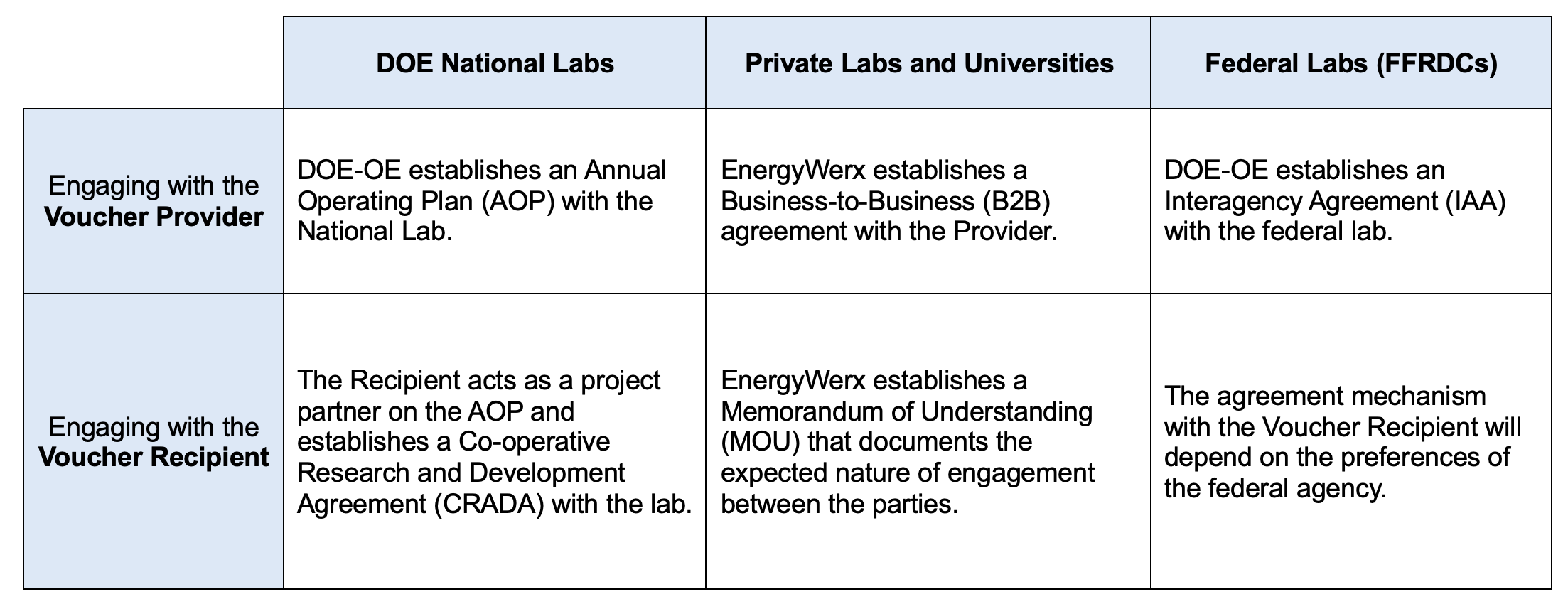
What project agreements are needed?

The project agreements depend on the type of Voucher Provider on the project. The following table describes the possible avenues.

How and when will the Voucher Providers be funded/invoiced?

All projects must complete the requisite milestones to receive funding. The method and timing of funding depend on the project agreement and Voucher Provider type. If the Voucher Provider is a National Laboratory, DOE-OE will disburse funding based on the conventional annual operating plan process. If the Provider is a federal lab, DOE-OE will disburse funding based on the Interagency Agreement Process.

If the Provider is a private or university lab with a Business-to-Business agreement with ENERGYWERX, the project will be funded on an invoice-basis. Each milestone must be completed and approved by DOE-OE prior to submitting an invoice. The projects will receive 25% of the project cost from each invoice, unless otherwise specified in the Business-to-Business agreement and approved by DOE-OE.

Are there cost share requirements?

DOE and ENERGYWERX do not require direct cost share from Voucher Providers or Recipients. However, selected Recipients are expected to fund their own travel, arrangements, materials, shipping, personnel, and any other miscellaneous costs to ensure successful completion of the proposed project activities. No funding is distributed to Voucher Recipients through the VO. Voucher Providers, like National Labs, may have cost share requirements as a part of project agreements, which can include tracking of in-kind contributions. Voucher Recipients are expected to satisfy any requirements set within project agreements.