
Nuclear Reactor Safety Training and Workforce Development Program - Integrated Nuclear Workforce Partnership Initiative
Information
Description
The U.S. Department of Energy (DOE) Office of Nuclear Energy (NE) is expanding the Nuclear Reactor Safety Training and Workforce Development Program (NRST) through an Integrated Nuclear Workforce Partnership Initiative using a Partnership Intermediary Agreement (PIA).
The initiative will connect industry, labor, education and training providers, manufacturers and suppliers, apprenticeship organizations, workforce-development organizations, and regional, state, and local partners to address current and anticipated nuclear workforce and supply-chain demand.
The initiative will support demand-driven nuclear workforce development across five integrated lines of effort and may include, as appropriate, nuclear safety curriculum development, industry-recognized credentials, apprenticeships, bridge training, work-based learning, hands-on training implementation, and outreach engagement. Nuclear safety, quality, human performance, procedural discipline, and other nuclear-specific requirements will remain foundational across applicable workforce pathways.
DOE anticipates selecting up to three performers, with individual performer awards of up to $2 million, subject to the aggregate amount available for performer awards and the scope negotiated in each Business-to-Business (B2B) Agreement.
Teaming Partner Details
EnergyWerx is compiling a Teaming Partner List[1] to facilitate the formation of project teams for this Opportunity. The Teaming Partner List allows entities that may wish to participate in a project to express their interest to other applicants and explore potential partnerships.
- Interested entities may apply to the Teaming Partner List HERE
- The Teaming Partner List can be viewed HERE (Password is case sensitive: NRST) and will be updated regularly to reflect new teaming partners who provide their organization's information.
[1] DISCLAIMER: By submitting a request to be included on the Teaming Partner List, the requesting organization consents to the publication of the referenced information. By facilitating the Teaming Partner List, DOE is not endorsing, sponsoring, or otherwise evaluating the qualifications of the individuals and organizations that are identifying themselves for placement on this Teaming Partner List. DOE will not pay for the provision of any information, nor will it compensate any applicants or requesting organizations for the development of such information.
Objective
The objective of the NRST Integrated Nuclear Workforce Partnership Initiative is to establish a scalable, demand-driven workforce model that:
- Increases qualified workforce capacity in critical nuclear occupations;
- Aligns workforce development with documented nuclear project, regional, employer, manufacturer, and supplier demand;
- Expands apprenticeship, technical education, work-based learning, and training capacity;
- Strengthens education- and training-to-employment pipelines;
- Supports workforce outreach and engagement; and
- Demonstrates scalable and sustainable regional workforce models.
The initiative is organized around five Integrated Lines of Effort:
1. Construction & Skilled Trades
Map, build, and mobilize skilled craft capacity for nuclear construction, modernization, outages, and commissioning through aligned apprenticeship and workforce systems. Activities may include demand mapping, craft-gap analysis, expansion of apprenticeship capacity, nuclear-specific bridge training, work-based learning, and project- or region-specific workforce mobilization.
2. Nuclear Manufacturing & Supply Chain
Strengthen the workforce supporting domestic nuclear manufacturing, including machining, fabrication, welding, component production, inspection, testing, instrumentation, quality control, and related occupations. Particular emphasis may be placed on connecting small and mid-sized manufacturers and suppliers with scalable workforce-development resources and regional training capacity.
3. Operations & Technical Workforce
Develop workforce pathways for occupations needed to safely operate, maintain, and sustain nuclear facilities. Relevant occupations may include operations, maintenance, radiation protection, chemistry, instrumentation and controls, electrical and mechanical systems, testing, inspection, quality, and other technical occupations.
4. Regional Training & Workforce Pathways
Align employers, education, labor, apprenticeship, workforce, and training providers through regional partnerships tied to verified nuclear workforce demand. Applicants should leverage existing infrastructure before creating new capacity and establish clear pathways from recruitment and training to qualification and employment.
5. Performance, Scaling & Sustainability
Establish common performance measures, evaluate workforce outcomes, identify effective models, leverage public and private resources, and replicate successful approaches across projects and regions. Performance should emphasize workforce capacity and employment outcomes rather than activity counts alone.
Important Dates
Submission Deadline(s)
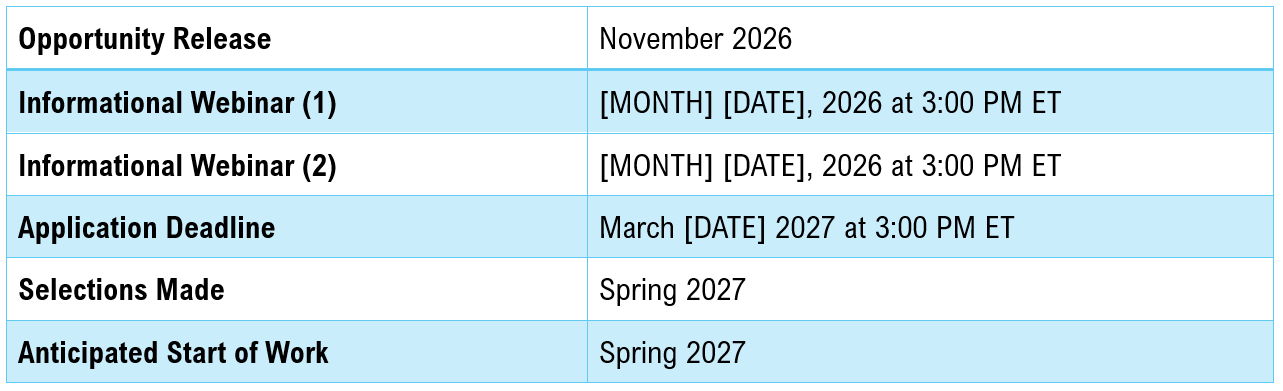
Submission Window: November _, 2026 - March _, 2027
Submissions are due no later than March _, 2027 at 3:00 PM ET
DOE Announcement
The Nuclear Reactor Safety Training and Workforce Development Program - Integrated Nuclear Workforce Partnership Initiative is anticipated to launch in November 2026. Please click here for the full announcement article for more information.
The initiative is being coordinated with the related NRST Notice of Funding Opportunity to support a complementary approach to nuclear safety training and workforce development. The PIA is intended to broaden engagement and connect workforce investments across employers, training providers, workforce organizations, state and local governments, and other organizations and regions.
Informational Webinar(s)
Informational Webinars: DOE will present and summarize the details of the NRST - Integrated Nuclear Workforce Partnership Initiative Opportunity. Potential applicants will gain a better understanding of the NRST's scope, scale, and intent and have the opportunity to ask questions of DOE staff.
- Register for the Informational Webinar on [MONTH] [DATE], 2026 from 3:00-4:00 PM ET
- Focuses predominantly on explaining the Voucher Opportunity with some time for questions at the end.
- Register for the Informational Webinar on [MONTH] [DATE], 2026 from 3:00-4:00 PM ET
- Focuses predominantly on answering questions from potential applicants.

For an optimal experience, we recommend downloading the Microsoft Teams software to your computer, smartphone, or tablet.
Process Details
Timeline(s)
Link(s) to Apply
Submission Window: November _, 2026 - March _, 2027
Submissions are due no later than March _, 2027 at 3:00 PM ET
Eligibility & Review Criteria
Eligibility Criteria
Applicants must be domestic entities meeting applicable DOE requirements and are expected to assemble multidisciplinary teams and partnerships necessary to accomplish the program objectives.
To qualify as a domestic entity, an applicant must:
- Be organized, chartered, incorporated, or otherwise formed under the laws of a state or territory of the United States;
- Have majority domestic ownership and control; and
- Have a physical place of business in the United States.
Eligible prime applicants include, but are not limited to:
- Community colleges
- Qualifying trade and technical schools
- U.S. institutions of higher education
- For-profit entities
- Nonprofit entities
- State and local governmental entities
- Indian Tribes / Tribal entities, as DOE determines appropriate
- Labor organizations / unions
- Utilities
Applicants must certify that they are not owned by, controlled by, or subject to the jurisdiction or direction of a government of a foreign country of concern. Individuals participating in a Malign Foreign Talent Recruitment Program are prohibited from participating in projects selected for federal funding under this Opportunity.
A foreign country of concern is defined in the SOO as the People's Republic of China, Democratic People's Republic of Korea, Russian Federation, Islamic Republic of Iran, or another country determined to be a country of concern by the Secretary of State.
Additional Eligibility / Program Requirements
Office of Nuclear Energy Mission Alignment
Applications must demonstrate a strong tie to at least one Office of Nuclear Energy mission goal and clearly explain how the proposed project supports the intended purpose of the program.
Applications focused specifically on fusion energy, medical physics, nuclear forensics, or environmental management will not be reviewed or considered.
Round 1 NRST Awardees
Prime awardees from either Topic Area 1 or Topic Area 2 of the first NRST funding opportunity are eligible to apply. These applicants must demonstrate how the proposed activities leverage, complement, or build upon their Round 1 NRST work. Proposed activities must be distinct from and may not duplicate work, activities, deliverables, or work plans previously funded under the Round 1 award.
Priority Consideration
Institutions of higher education located in proximity to nuclear power plants with decades of operational safety experience are expected to receive priority consideration.
Cost Share
The program requires a minimum cost share of 20% of total project costs. Cost share must come from non-federal sources unless otherwise allowed by law.
National Laboratories / DOE/NNSA FFRDCs
National Laboratories and DOE/NNSA FFRDCs may participate as consortium members and provide technical context, nuclear-readiness competencies, convening support, and access to relevant capabilities as appropriate. Under the PIA mechanism, National Laboratories are limited to an aggregate total of 10% of total project funding.
Review Criiteria
Applications should demonstrate the following:
Mission and Program Alignment
A strong connection to the Office of Nuclear Energy mission and the objectives of the NRST Integrated Nuclear Workforce Partnership Initiative.
Documented Workforce Demand
A clear connection to verified nuclear project, employer, regional, manufacturer, or supplier workforce demand.
Integrated Workforce Approach
A credible approach addressing one or more of the five Integrated Lines of Effort and connecting recruitment, training, apprenticeship, qualification, employment, retention, and workforce planning as appropriate.
Quality and Strength of Partnerships
Multidisciplinary partnerships with clearly defined roles and contributions from appropriate employers, manufacturers, suppliers, education and training providers, labor organizations, apprenticeship organizations, workforce partners, governmental entities, and other relevant organizations.
Existing Infrastructure and Avoidance of Duplication
Demonstrated awareness of existing training programs, workforce infrastructure, and key partners and a clear explanation of how the proposed effort will leverage existing capabilities rather than unnecessarily duplicate them.
SMART Project Plan and Milestones
A Specific, Measurable, Attainable, Relevant, and Time-based action plan with measurable milestones and outcomes.
Nuclear Safety and Workforce Readiness
Appropriate incorporation of nuclear safety culture, quality, human performance, procedural discipline, nuclear-specific requirements, and relevant workforce qualifications.
Measurable Workforce Outcomes
Expected outcomes may include:
- Participation and completion
- Credential or qualification attainment
- Apprenticeship and work-based learning participation
- Employment placement and career progression
- Retention, where measurable
- Employer participation
- Training and apprenticeship capacity expansion
- Resources leveraged
- Curriculum adoption and quality improvement
- Sustainability and replication of successful approaches
Sustainability and Scalability
A credible plan for sustaining successful training, credentials, partnerships, and workforce pathways beyond the period of federal support and, where appropriate, replicating successful approaches across projects and regions.