Deadline
-
TBD
April 16, 2026
3:00 pm
ET

iCRS-D - i2X Interconnection Cost Reduction Solutions for Distribution Program

Information

Start the iCRS-D Application (Submissions are due no later than April 16, 2026 at 3:00 PM ET)

Description

ENERGYWERX, through a Partnership Intermediary Agreement (PIA) with the U.S. Department of Energy (DOE) Interconnection Innovation e-Xchange (i2X) program, is looking to fund pilot tests of innovative interconnection solutions under the Interconnection Cost Reduction Solutions for Distribution (iCRS-D) program. This program will help address the National Energy Emergency by supporting innovations to streamline and expedite interconnection services by implementing cutting-edge technology solutions, such as grid enhancing technologies, grid-interactive loads, flexible interconnection, micro-grids, and many other innovations. The iCRS-D program aims to reduce interconnection costs related to grid upgrades by 70% for generators, large loads, and hybrid facilities connecting to the distribution grids.

To usher in a new era of American prosperity, we must ensure all Americans and domestic industries have access to affordable, reliable, and secure electricity. United States electricity demand is growing at an extraordinary pace due to the rapid rise of large commercial and industrial loads (e.g., data centers) and electrification. The challenge is compounded as Americans face rising electricity prices across the country.

The iCRS-D program will provide $4 million to fund up to four organizations, each of which will lead a multi-stakeholder partnership at the local, state, or regional level. Each partnership will execute a Lighthouse Project - a pilot program that develops and demonstrates new technologies and effective solutions – to increase data access and transparency, streamline and expedite interconnection services, and maximize economic efficiency. Lead organizations, with their partners, will apply their distribution-level interconnection expertise to prioritize and adapt practical solutions for load and generation interconnection. These efforts will deliver tested approaches to scalable interconnection innovations that improve processes, reduce overall costs, and maintain a reliable grid.

Objective

Background

The mission of i2X is to enable simple, fast, and affordable interconnection while enhancing the reliability and security of our electric grid. To solve complex interconnection challenges collaboratively, i2X developed practical solutions for distributed energy resources interconnection through extensive stakeholder engagement (for example solutions, see FAQ section). These solutions address key issues such as data transparency, process simplicity, grid reliability, and economic efficiency of interconnection services in the distribution grid. Each solution includes actionable steps and collaborative activities for interconnection stakeholders, such as distribution utilities, energy project developers, state and local governments, research institutions, and public interest organizations. DOE also launched the Collaborations Advancing Rapid Load Additions (CARLA) in 2025. CARLA focuses on developing new approaches for system planning, cost recovery, and risk allocation for electricity demand growth, in ways new large loads are added faster while minimizing risks of electricity rate increases for households and small businesses.

Challenge

The demand for electricity in the United States has increased rapidly for the past few years as homes, commercial buildings, and industrial facilities electrify, manufacturing hubs expand, and energy-intensive sectors, such as artificial intelligence (AI) and data centers, continue to grow. Current grid capabilities and interconnection services are unable to meet America’s rising energy needs effectively and efficiently. Current challenges include inefficient regional processes and management systems that increase interconnection timelines, insufficient grid hosting capacity and data access that inhibit effective planning and add unnecessary costs, and a need for innovative interconnection services to support solutions that maximize grid use and mitigate costly grid upgrades (such as hybrid facilities and flexible interconnection). There is an urgent need to rapidly transform the current system and unleash American energy to keep pace with the growing electricity demand.

Administration Priorities

On January 20th, 2025, the White House declared a National Energy Emergency and followed with a call to action through the executive orders Removing Barriers To American Leadership In Artificial Intelligence and Unleashing American Energy. In response to these priorities, i2X supports and augments DOE actions to maximize the use of federal resources such that state and local governments, utilities, grid operators, grid customers, and other stakeholders address interconnection constraints and meet new demand in a cost effective and efficient manner.

Focus

The iCRS-D program aims to address distribution grid interconnection challenges with $4 million to directly fund up to four lead organizations to each manage a local, state, or regional partnership.

These partnerships will develop and implement Lighthouse Projects that remove barriers, streamline processes, and reduce overall costs of distribution interconnection using practical solutions. Efforts may address features across the planning and operations of the distribution grid to increase data access and transparency, streamline and expedite interconnection services, and maximize economic efficiency. Partnerships will define quantitative outcome goals and evaluate performance against them. See the FAQ section for examples.

Through the implementation of their Lighthouse Projects, partnerships will facilitate cross-learning, conduct analytical research and modeling, provide subject-matter expertise to support technical innovation, pilot solutions in a local environment, and detail outcomes and lessons learned in interconnection innovation.

Funding Levels

Selected lead organizations will receive up to $1 million.

Duration

2 years

Areas of Interest

Projects should implement process and technology solutions in the distribution system that aim to improve interconnection timelines and costs by maximizing economic efficiency, increasing data access and transparency or by streamlining services. Topical solution examples include, but are not limited to:

  • Maximize Economic Efficiency: Better accommodate growth and mitigate costly system upgrades
    • Develop integrated grid planning
    • Proactively upgrade feeder circuits
    • Design future-ready industrial parks for energy-intensive industries (e.g. data centers)
    • Develop processes for flexible interconnection and co-located generation (i.e. hybrid facilities and/or microgrids)
  • Increase data access and transparency: Aid project development and cost estimation
    • Increase public access to aggregated, anonymized grid data
    • Implement advanced hosting capacity analysis and services (e.g. dynamic host capacity)
    • Identify grid sections that host surplus interconnection services and capacity, avoiding costly upgrades
    • Integrate grid enhancing technologies
  • Streamline and expedite interconnection services: Facilitate efficient screening methods and remove undue burdens
    • Harmonize interconnection procedures across service territories, especially for affected system studies
    • Automate management systems and technical screens
    • Provide fast tracking and expedited services based on system impact, controls, and potential grid services
    • Implement cluster studies for efficient permitting and grid upgrades cost mitigation or sharing
    • Increase energy project readiness requirements and incentives streamlined processes
*NOTE: Applicants are encouraged to use the Teaming Partner List to connect with partners interested in similar topic areas within the same geographic regions.

Projects Specifically Not of Interest

  • Projects that focus on one specific generation source or load type.
  • Projects on the national-scale or led by a national actor with no expertise in the local, state, or regional priorities or goals.
  • Projects that focus solely on convening stakeholders or conducting research to produce new frameworks, grid modeling capabilities, propose new electricity regulations, or compile strategies for improving interconnection practices.
  • Projects that focus solely on transmission-level solutions (please see the Interconnection Cost Reduction Solutions for Transmission Voucher Program iCRS-T).
  • Projects that focus on marketing efforts or business development activities for existing or new solutions or products.
  • Projects to support or fund specific interconnection applications or service requests.
  • Projects that propose solutions or technologies not based on sound scientific principles (e.g., violates the laws of thermodynamics).

Event Updates

How to Participate

ENERGYWERX is compiling a Teaming Partner List to facilitate the formation of project teams for this Opportunity. The Teaming Partner List allows entities that may wish to participate in a project to express their interest to other applicants and explore potential partnerships.

  • Interested entities may apply to the Teaming Partner List HERE
  • The Teaming Partner List can be viewed HERE (Password is case sensitive: icrsd) and will be updated regularly to reflect new teaming partners who provide their organization’s information.

Participating in the Informational Webinars will improve your knowledge in the expectations of the opportunity and application.

For an optimal experience, we recommend downloading the Microsoft Teams software to your computer, smartphone, or tablet.

Complete the submission form and upload the appropriate project information and supporting documentation.

Important Dates

DOE Announcement

Objective Strategic Session (OSS) Webinar

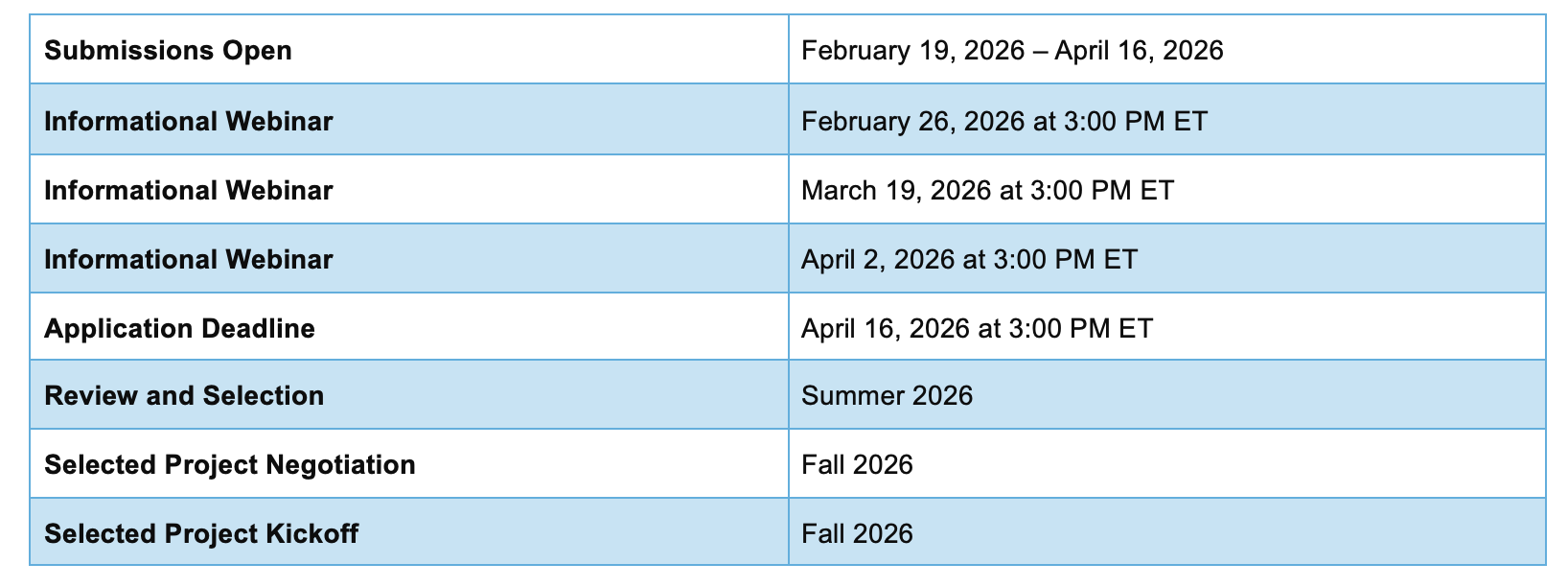
Informational Webinar: Join ENERGYWERX and the i2X team for an Informational Webinar on the iCRS-D - Interconnection Cost Reduction Solutions for Distribution Grid Program on February 26, 2026 from 3:00-4:00 PM ET.

For an optimal experience, we recommend downloading the Microsoft Teams software to your computer, smartphone, or tablet.

Office Hours (OH) Q&A Webinar

Informational Webinar(s): ENERGYWERX and the i2X team will host an open Q&A session for potential iCRS-D applicants. Participants are encouraged to come prepared to ask questions.

For an optimal experience, we recommend downloading the Microsoft Teams software to your computer, smartphone, or tablet.

Submission Deadline(s)

Submission Window: February 19, 2026 - April 16, 2026

Start the iCRS-D Application (Submissions are due no later than April 16, 2026 at 3:00 PM ET)

Process Details

Timeline(s)

Resources from Webinar(s)

Coming soon.

Slide Deck(s)

Coming soon.

Transcript(s)

Coming soon.

Video Recording(s)

Coming soon.

Webinar Q&As

Coming soon.

Eligibility & Review Criteria

Eligibility Criteria

All applicants must meet the following requirements:

  • Applicant must qualify as a domestic entity. To qualify as a domestic entity, the entity must be organized, chartered, or incorporated (or otherwise formed) under the laws of a particular state or territory of the United States. The entity must have majority domestic ownership and control and have a physical place of business in the United States.
  • Applicant must certify that it is not owned by, controlled by, or subject to the jurisdiction or direction of government of Country of Risk. The U.S. Department of Energy defines Country of Risk to include China, Russia, North Korea, and Iran. This list is subject to change.
  • Any applicant that is an Investor-Owned Utility will be required to provide a 50% cost share.

Merit Review Process & Evaluation Criteria

The i2X team will review and evaluate each application according to the merit review criteria, program policy factors, and the overall portfolio of proposed projects. In conducting the review, the teams may seek the advice of qualified non-federal personnel as reviewers. The applicant, by submitting its application, consents to the use of non-federal reviewers. The merit review criteria consist of statements in three parts. 

Review Criteria

Application Merit Review Criteria

Criteria 1: Scope and Partnership

  • The applicant demonstrates a thorough understanding of existing interconnection practices, highlighting limitations and deficiencies.
  • The proposed project describes solutions that can reduce costs and reduce barriers associated with interconnection services for generators, large loads, and/or hybrid facilities on the distribution grid of the targeted region.
  • The project team is a multi-stakeholder partnership composed of organizations (e.g. distribution utility, state regulator, state government) with expertise, capabilities, and authority to implement the Lighthouse project.
  • The applicant demonstrates strong interest from partnering organizations (e.g., letters of intent).
  • The applicant includes signed partnership agreements or commitments from organizations key to implementing the Lighthouse project (e.g. state government, state regulator, distribution utility).
  • The project team includes key personnel who have expertise, capabilities, and the decision-making authority to implement the Lighthouse project.
  • The proposed project aligns well with the goals and priorities of key team member organizations such as distribution utilities and state regulators.

Criteria 2: Work Plan and Feasibility

  • The proposal includes specific and feasible activities for the Lighthouse Project (stakeholder engagement, solution development and implementation, and field demonstration).
  • The proposal includes specific and feasible milestones for the Lighthouse Project (stakeholder engagement, solution development and implementation, and field demonstration).
  • The proposal includes specific and feasible outputs for the Lighthouse Project (stakeholder engagement, solution development and implementation, and field demonstration).
  • The proposal identifies potential risks to project success and provides appropriate mitigation strategies.
  • The proposal includes key performance indicators/measurable outcomes that are specific and feasible to assess.

Criteria 3: Impact and Scalability

  • The Lighthouse Project, if realized, will sufficiently impact interconnection costs and timelines.
  • The Lighthouse Project, if realized, will reduce projected interconnection costs by at least 50%.
  • The Lighthouse Project can be readily adopted locally.
  • The Lighthouse Project is scalable and can be adopted at state or regional levels.
  • The proposal clearly defines how the partnership will quantitatively and qualitatively measure the success of the Lighthouse Project.
  • The proposal includes a plan for sharing the partnership’s findings with a broader audience.
  • The partnership has a clear vision to sustain the interconnection process improvements beyond the funding period, including strategies for embedding them within existing regulatory and utility practices.

Program Policy Factors

The i2X Program will apply the following program policy factors when reviewing and evaluating applications to select the most impactful projects aligning with national priorities.

  • Alignment with i2X Program Objectives: The proposed project strongly aligns with the goals, priorities, and ongoing activities of the Interconnection Innovation e-Xchange (i2X) program.
  • Support for DOE Priorities: The proposed project advances key DOE energy goals related to grid modernization, streamlining of interconnection processes, cutting of bureaucratic red tape, and energy addition.
  • Regional Impact and Replicability: The proposed project demonstrates potential for significant regional impact and the ability to be replicated in other regions facing similar interconnection challenges.
  • Geographic Diversity: The proposed project expands the geographic diversity of organizations and regions participating in DOE-supported interconnection initiatives.
  • Leveraging Existing Resources: The partnerships effectively leverage existing resources, initiatives, and expertise within the region to maximize the impact of the project.

Frequently Asked Questions

May an FFRDC or a National Lab apply?

DOE will not directly fund National Labs*/FFRDCs via this Partnership Intermediary Agreement (PIA) Opportunity; however, FFRDCs (e.g. DOE/National Nuclear Security Administration national laboratories) may participate as a Selectee’s subrecipient.  The FFRDC effort, in aggregate, shall not exceed 10% of total federal share of the project, and ENWX and DOE will not be involved in, nor assist in, these activities.  Selectees will receive full funding through a Business-to-Business (B2B) Agreement with ENWX.  Selectees are solely responsible for funding and executing necessary agreements with subrecipients.  

*Caveat:  NLs may be Voucher Providers and may apply, but if selected, DOE will manage the work and pay the NL directly through the existing funding mechanism.

‍What are Smart Manufacturing and high-performance computing?

For the purposes of this opportunity:

“Smart Manufacturing” means advanced technologies in information, automation, monitoring, computation, sensing, modeling, artificial intelligence, analytics, and networking that can -

  • simulate manufacturing production lines;
  • operate computer-controlled manufacturing equipment;
  • monitor and communicate production line status; and
  • manage and optimize energy productivity and cost throughout production;
  • model, simulate, and optimize the energy efficiency of a factory building;
  • monitor and optimize building energy performance;
  • model, simulate, and optimize the design of energy efficient and sustainable products, including the use of digital prototyping and additive manufacturing to enhance product design;
  • connect manufactured products in networks to monitor and optimize the performance of the networks, including automated network operations; and
  • digitally connect the supply chain network.16

“High-Performance Computing” means the use of supercomputers, sophisticated models, and/or large data sets to study and solve complex scientific and technological challenges.

What exactly is a “small- and medium-sized manufacturer”?

The term “small- and medium-sized manufacturer” (SMM) means manufacturing firms:

  • classified in the North American Industry Classification System (NAICS) as any of sectors 31 through 33;
  • with gross annual sales of less than $100,000,000;
  • with fewer than 500 employees at the plant site; and
  • with annual energy bills totaling more than $100,000 and less than $3,500,000
Who is eligible to receive funding?

Refer to Section III.G.2. Eligibility Requirements in the Solicitation Overview.

An application’s prime recipient must be one of the following eligibility entities, else the application will be considered ineligible and removed from further evaluation:

  • State entity;
  • State-funded university; or
  • State-funded community or technical college
Are applicants required to provide cost share?

Yes, cost sharing is required under this solicitation. Applicants are required to provide at least a 23.1% cost share, i.e. applicants need to fund a minimum of 23.1% of the total project cost. Cost share can come from any non-federal source, i.e. cash on hand, philanthropy, corporate investment, etc.

What is the difference between "cost sharing" and "cost match"?

Refer to the Cost Share handout for more detail and examples.

  • While the terms “cost sharing” and “cost matching” are sometimes used interchangeably, there is an important distinction between them. DOE uses “cost sharing” to indicate that the non- federal share is calculated as a percentage of the Total Project Cost. On the other hand, for “cost matching”, the non-federal match is calculated as a percentage of the federal funds only, rather than the Total Project Cost.
  • The statutory language that authorizes the State Manufacturing Leadership Program requires proponents to provide at least 30 percent cost match. For the purposes of this solicitation, the 30 percent cost matching requirement has been converted to an equivalent 23.1 percent cost sharing requirement
What are the acronyms SMM, HPC, and SLMP?
  • SMM = small- and medium-sized manufacturers
  • HPC = high-performance computing
  • SMLP = State Manufacturing Leadership Program
  • IAC = Industrial Assessment Center
  • ITAC = Industrial Training and Assessment Center
  • TA = Technical Assistance
Why did the solicitation come down mid-January?

The solicitation was temporarily taken down while DOE and ENERGYWERX confirmed that the language was consistent with recent Executive Orders.

What is an Opportunity?

Understanding Opportunities

An opportunity is a favorable circumstance or situation that allows for the potential to achieve a goal or benefit. In various contexts, opportunities can arise in business, education, and personal development. Recognizing and seizing these moments can lead to significant advancements in one's career or personal life.

Types of Opportunities

  • Career Opportunities: Job openings or promotions that can enhance your professional journey.
  • Educational Opportunities: Programs or courses that provide knowledge and skills.
  • Networking Opportunities: Events or platforms that allow you to connect with others in your field.
Download

May an FFRDC or a National Lab apply?

DOE will not directly fund National Labs*/FFRDCs via this Partnership Intermediary Agreement (PIA) Opportunity; however, FFRDCs (e.g. DOE/National Nuclear Security Administration national laboratories) may participate as a Selectee’s subrecipient. The FFRDC effort, in aggregate, shall not exceed 10% of total federal share of the project, and ENWX and DOE will not be involved in, nor assist in, these activities.  Selectees will receive full funding through a Business-to-Business (B2B) Agreement with ENWX. Selectees are solely responsible for funding and executing necessary agreements with subrecipients.  

*Caveat: NLs may be Voucher Providers and may apply, but if selected, DOE will manage the work and pay the NL directly through the existing funding mechanism.

How much funding will be provided to applicants, if selected?

Each application, if selected, may be awarded up to $1 million.

Do projects need to address specific solutions developed by i2X?

The projects do not have to address specific solutions developed by i2X, but applicants are highly encouraged to use example solutions provided in the FAQ section under “What type of solutions are encouraged?'"

What types of solutions are encouraged?

Example solutions to adapt for the Lighthouse Project may include:

  • Increase data access and transparency:
    • Expand and standardize reporting of interconnection data, including project attributes and interconnection cost estimates.
    • Standardize and clarify the technical data that developers of large, distributed energy systems must provide on interconnection applications to facilitate interconnection studies.
    • Establish and maintain frequently updated hosting capacity analysis (HCA) tools that model the impact of multiple types of distributed energy technologies on the grid. Further, broaden the use cases of HCA, such as for interactive maps of low-cost, capacity available interconnection regions.
  • Streamline and expedite interconnection services:
    • Establish and require that large interconnection applicants meet clear criteria for commercial readiness and enforce appropriate interconnection study timelines with penalties for delays in completing studies to quicken queue-dwell times.
    • Automate parts of the interconnection application process and, where possible, streamline completion of interconnection studies.
    • Use a group study process to address existing queue backlogs or avoid anticipated queue backlogs.
  • Maximize economic efficiency:
    • Enable flexible interconnection, consider load and export capacity for hybrid facilities, and account for potential grid services in interconnection studies to defer grid upgrades and avoid delays.
    • Use a group study process to reduce per-project interconnection upgrade costs by allocating costs among multiple projects based on their contribution to the triggered upgrade.
    • Improve coordination and data sharing between the interconnection process and the system planning process to promote synergy between the two.
    • Proactively upgrade feeder circuits to accommodate forecasted generation and load growth and recover costs from future developers who share the upgraded feeder circuits.

Further example solution topics can be found in the Objective section under “Areas of Interest”.

What types of measurable project outcomes are encouraged?  

Projects that detail solution(s) with a direct pathway to the outcomes listed below:

  • 70% reduction in projected interconnection costs related to grid upgrades.
  • Reduction in median timeline from request to interconnection agreement to:
    • Less than one day for small systems (< 50kilowatts (kW)).
    • Less than 75 days for medium systems (50 kW – 5megawatts (MW)).
    • Less than 140 days for large systems (> 5 MW).
  • Increasing completion rate from entering the interconnection queue to executing the interconnection agreement to:
    • > 99% for small systems (< 50 kW).
    • > 90% for medium systems (50 kW – 5 MW).
    • > 85% for large systems (> 5 MW).
  • Availability of public, detailed, and current state-level interconnection queue data.
  • Ensuring zero disturbance events on the bulk power system exacerbated by inaccurate distributed energy resource modeling.

Are there any restrictions on how many applications an organization can submit?

Yes, each lead organization can submit only one application.

Can an organization submit an application with two target regions?

Yes, organizations may have two target regions in the application if the reach of expertise of the partnership supports the ability to do so.

Questions

For additional questions, please contact info@energywerx.org

Quick Links